
The Cheapest Healthy Way to Own a Cat

The Cheapest Healthy Way to Own a Cat
There is a floor below which cat ownership stops being frugal and starts being neglect, and it sits higher than most people guess — but not by much. Done deliberately, a cat can live a long, healthy, fully-vetted life for roughly $1,595 in year one and about $815 a year after that (2025 US prices). This guide walks the Essential tier of our cat cost calculator line by line, showing exactly where the savings are real, where they’re an illusion, and the handful of lines you should never cut at any income.
Start right: adopt an adult from a shelter
The single biggest saving happens before the cat comes home. A shelter adoption fee of $75–$200 typically bundles the spay or neuter ($150–$350 bought separately), the first vaccine round, a microchip ($40–$75) and often a first vet exam. That bundle is worth $400–$600 at private-clinic prices, which makes the adopted adult cat the best-value pet in America. Choosing an adult over a kitten saves again: no three-visit kitten vaccine series ($150–$300), less destruction during the feral toddler phase, and a personality you can actually assess at the shelter. Kittens are wonderful; they are also a surcharge.
Food: the safe place to save — carefully
Food is the largest recurring line, and it’s where frugal owners look first. The honest picture: a cat needs complete, balanced nutrition meeting AAFCO standards, appropriate protein, and enough moisture. Beyond that threshold, price and quality correlate weakly. A store-brand or mid-range food that carries the AAFCO “complete and balanced” statement feeds a cat properly for $25 a month; boutique grain-free and freeze-dried diets at $80 a month have never been shown to add years to a healthy cat’s life, and some boutique formulations have been investigated over links to heart disease in dogs — expensive is not a synonym for safe. Two genuinely smart moves: buy the largest bag you’ll use within six weeks (dry food stales once opened), and consider mixing in affordable wet food a few times a week, because hydration is the cheapest kidney insurance a cat can get. Where not to save: the bargain-bin food with no AAFCO statement, and all-tuna or dog-food diets, which are nutritionally incomplete for cats in ways that cause real harm.

Litter: buy boring, buy in bulk
Litter is a top-three annual cost ($200 at Essential versus $550 at Premium) and the differences between brands are mostly perfume and packaging. Plain clumping clay litter bought in 35–40 lb bags runs about $16 a month for one cat — roughly half the per-pound price of the same litter in small scented tubs. A high-sided storage tote makes a perfectly good second litter box for a third of the pet-store price. The rule that matters is quantity of boxes, not luxury of litter: one box per cat plus one spare, scooped daily. Skimp on that and you’ll pay the saving back in carpet cleaning and a vet visit for stress-related urinary issues.
Vet care: the lines you never cut
Frugal cat ownership is not vet-free cat ownership. The non-negotiables are short and specific: the core vaccine series and rabies vaccination as scheduled; annual check-ups (twice-yearly from age ten); parasite prevention appropriate to lifestyle; dental attention when your vet flags disease; and spay/neuter if your shelter didn’t already do it. Bought at the right places, this layer is cheaper than people fear: vaccine clinics and shelter wellness days vaccinate for $15–$30 a shot, low-cost spay programmes charge $50–$150, and a check-up is $50–$100 once a year. The full price map is in our vet bills guide. What actually bankrupts cat owners is not the $75 check-up — it’s the skipped check-up that lets a $200 dental or a treatable thyroid issue mature into a $2,500 crisis. Keep an indoor cat indoors, too: it’s the largest risk reduction available at any price, and it’s free.
Gear and enrichment: spend once, spend cheap
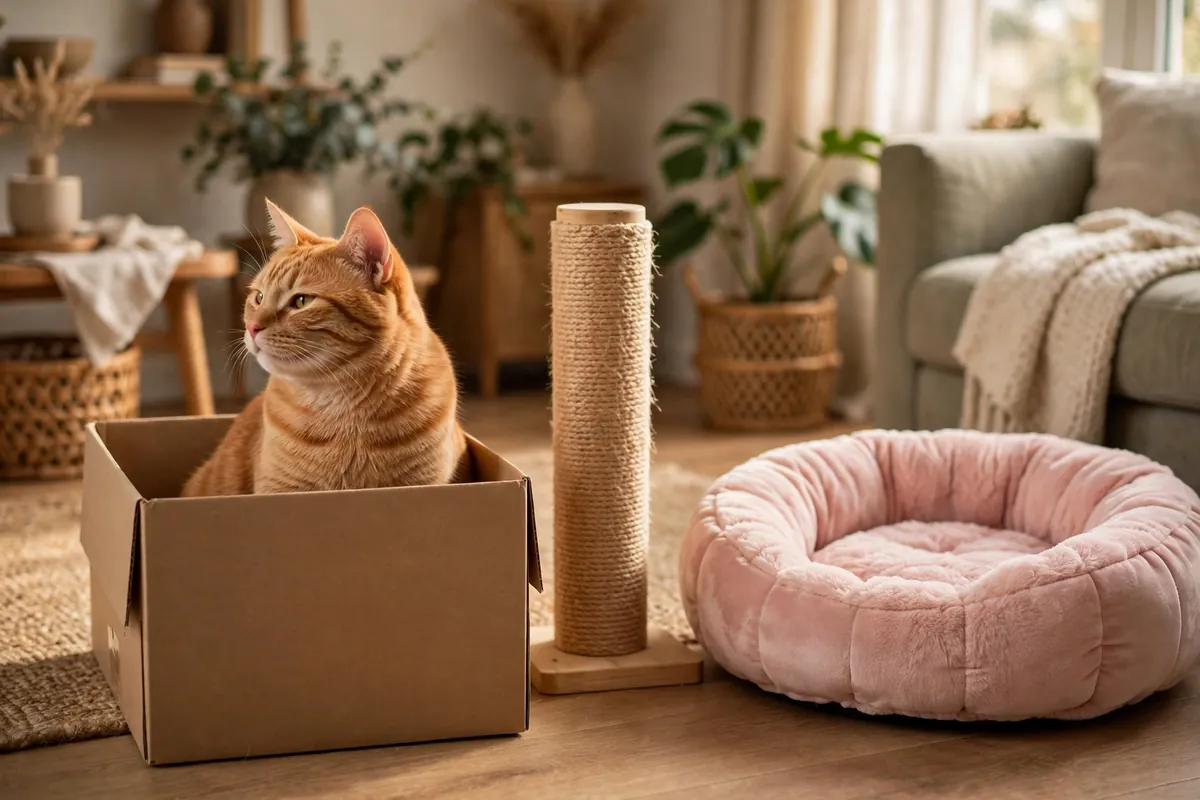
The Essential starter kit — carrier, litter setup, scratcher, bed, bowls — totals about $130 when bought plainly. A sturdy hard-sided carrier is worth its modest price (it’s also your emergency transport), while the $90 designer cat bed will lose to the cardboard box it shipped in, every time. Scratching posts protect furniture worth far more than they cost; a $25 sisal post is a genuine saving. Toys rotate: a wand toy, some balls, and the endless free supply of boxes and paper bags outperform a $60 electronic gadget the cat ignores by Thursday. Grooming is a brush and five minutes a week — long-haired breeds excepted, cats are magnificently self-maintaining.
The Essential-year budget, totalled
Adding it up from our calculator: adoption $125 + spay/neuter (if not bundled) $200 + first vet and vaccines $275 + microchip $50 + starter supplies $130 = $780 one-off; food $300 + litter $200 + routine vet $175 + prevention $60 + supplies $80 = $815 recurring — a first-year total of $1,595, which you can reproduce in the cat calculator at the Essential tier, settling to $815 a year (about $68 a month) thereafter. Add a modest emergency contribution — even $40 a month toward the fund described in our emergency fund guide — and the whole honest enterprise runs near $110 a month. That is the cheapest healthy way to own a cat: not the cheapest way imaginable, but the cheapest way that still deserves the word “care”.
Figures are 2025 US price ranges from the PawCosts cat calculator’s Essential tier. PawCosts provides cost guidance only, not veterinary advice — discuss diet and care choices for your individual cat with your veterinarian.